Thursday, April 12, 2018

Facebook CEO Mark Zuckerberg to Capitol Hill: ‘It was my mistake, and I’m sorry.’

Facebook CEO Mark Zuckerberg expressed contrition for allowing third-party apps to grab the data of its users without their permission and for being “too slow to spot and respond to Russian interference” during the U.S. election, according to his prepared remarks published by the House Energy and Commerce Committee.
Zuckerberg plans to open his remarks with a familiar recitation of the social media platform’s ability to link far-flung people together but then pivot into an acknowledgment of Facebook’s increasingly visible dark side.
“It’s clear now that we didn’t do enough to prevent these tools from being used for harm as well,” Zuckerberg plans to tell lawmakers. “That goes for fake news, foreign interference in elections, and hate speech, as well as developers and data privacy. We didn’t take a broad enough view of our responsibility, and that was a big mistake. It was my mistake, and I’m sorry. I started Facebook, I run it, and I’m responsible for what happens here.”

The testimony’s release, ahead of the first of two hearings this week, came as a suit-clad Zuckerberg and some of his top lobbyists and aides made the rounds on Capitol Hill, huddling with lawmakers who planned to grill him Tuesday and Wednesday. The meetings included a session with Sen. Bill Nelson (Fla.), the top Democrat on the Commerce Committee, as a cluster of reporters waited outside.

Exiting that meeting, Zuckerberg ignored shouted questions from reporters. Nelson afterward said he pressed the Facebook chief executive on everything from its privacy practices to the efforts by Russian agents to spread disinformation on social media during the 2016 election.
“If we don’t rein in the misuse of social media, none of us are going to have any privacy anymore,” Nelson said.
The company has been reeling since the November 2016 election, during which phony news reports spread widely on its platform and Russian operatives mounted an ambitious campaign to divide American voters, damage Democratic candidate Hillary Clinton and bolster the chances of Republican candidate Donald Trump.
Facebook appeared to be recovering from those controversies until last month’s revelation that a political consultancy hired by Trump and other Republicans improperly gained access to data on 87 million Facebook users, including 71 million Americans. The company acknowledged last week a separate problem in which “malicious actors” were able to identify and collect data on Facebook users on such a massive scale that most of the company’s 2.2 billion users were affected.

As the company has mobilized to quell rising political opposition, including the possibility of major legislation affecting how technology companies handle user data, Facebook also is battling government investigations in the United States and Europe. The Federal Trade Commission is investigating alleged violations of a 2011 consent decree over privacy policy at Facebook that could lead to record fines against the company.

The release of the testimony, for Wednesday’s appearance before the House Energy and Commerce Committee, is part of a major public relations push by Facebook to acknowledge its failings in protecting user privacy and not acting quickly enough to thwart several Russian disinformation campaigns, including one during the 2016 presidential election.
Zuckerberg was scheduled to meet with Sen. John Thune (R-S.D.), chairman of the Commerce Committee, and Sen. Charles E. Grassley (R-Iowa), chairman of the Judiciary Committee. The Facebook chief executive also planned to appear before a Senate committee hearing on Tuesday. Those remarks are expected to be similar.
“It’s not enough to just connect people, we have to make sure those connections are positive,” Zuckerberg plans to say in his testimony. “It’s not enough to just give people a voice, we have to make sure people aren’t using it to hurt people or spread misinformation. It’s not enough to give people control of their information, we have to make sure developers they’ve given it to are protecting it too.”

Facebook has announced measures in recent weeks to tighten how it handles user data, bring new transparency to who is behind political advertising and work more openly with outside researchers, who long have complained that the company’s platform was walled off from meaningful analysis of its content and impacts.
The company on Monday also began notifying users whose data was improperly shared with Cambridge Analytica, the political consultancy hired by Trump and other Republicans. The kind of data-sharing that Cambridge Analytica took advantage of in 2014 was widespread among app developers before Facebook began tightening its data-use policies that year. Before the changes, outside app developers could gain access to a wide range of user data — including their full names, home towns, work histories, religious affiliations and Facebook “likes” — without the explicit permission of most users.
Among the pledges made by Zuckerberg is a promise to better protect Facebook from exploitation in time to safeguard the 2018 congressional election.

Here are Zuckerberg’s prepared remarks, as released by the House committee:

HEARING BEFORE THE UNITED STATES HOUSE OF REPRESENTATIVES COMMITTEE ON ENERGY AND COMMERCE

April 11, 2018

Testimony of Mark Zuckerberg

Chairman and Chief Executive Officer, Facebook

I. INTRODUCTION
Chairman Walden, Ranking Member Pallone, and Members of the Committee,
We face a number of important issues around privacy, safety, and democracy, and you will rightfully have some hard questions for me to answer. Before I talk about the steps we’re taking to address them, I want to talk about how we got here.
Facebook is an idealistic and optimistic company. For most of our existence, we focused on all the good that connecting people can bring. As Facebook has grown, people everywhere have gotten a powerful new tool to stay connected to the people they love, make their voices heard, and build communities and businesses. Just recently, we’ve seen the #metoo movement and the March for Our Lives, organized, at least in part, on Facebook. After Hurricane Harvey, people raised more than $20 million for relief. And more than 70 million small businesses now use Facebook to grow and create jobs.
But it’s clear now that we didn’t do enough to prevent these tools from being used for harm as well. That goes for fake news, foreign interference in elections, and hate speech, as well as developers and data privacy. We didn’t take a broad enough view of our responsibility, and that was a big mistake. It was my mistake, and I’m sorry. I started Facebook, I run it, and I’m responsible for what happens here.
So now we have to go through every part of our relationship with people and make sure we’re taking a broad enough view of our responsibility.
It’s not enough to just connect people, we have to make sure those connections are positive. It’s not enough to just give people a voice, we have to make sure people aren’t using it to hurt people or spread misinformation. It’s not enough to give people control of their information, we have to make sure developers they’ve given it to are protecting it too. Across the board, we have a responsibility to not just build tools, but to make sure those tools are used for good.
It will take some time to work through all of the changes we need to make, but I’m committed to getting it right.
That includes improving the way we protect people’s information and safeguard elections around the world. Here are a few key things we’re doing:

II. CAMBRIDGE ANALYTICA
Over the past few weeks, we’ve been working to understand exactly what happened with Cambridge Analytica and taking steps to make sure this doesn’t happen again. We took important actions to prevent this from happening again today four years ago, but we also made
mistakes, there’s more to do, and we need to step up and do it.

A. What Happened
In 2007, we launched the Facebook Platform with the vision that more apps should be social. Your calendar should be able to show your friends’ birthdays, your maps should show where your friends live, and your address book should show their pictures. To do this, we enabled people to log into apps and share who their friends were and some information about them.
In 2013, a Cambridge University researcher named Aleksandr Kogan created a personality quiz app. It was installed by around 300,000 people who agreed to share some of their Facebook information as well as some information from their friends whose privacy settings allowed it. Given the way our platform worked at the time this meant Kogan was able to access some information about tens of millions of their friends.
In 2014, to prevent abusive apps, we announced that we were changing the entire platform to dramatically limit the Facebook information apps could access. Most importantly, apps like Kogan’s could no longer ask for information about a person’s friends unless their friends had also authorized the app. We also required developers to get approval from Facebook before they could request any data beyond a user’s public profile, friend list, and email address. These actions would prevent any app like Kogan’s from being able to access as much Facebook data today.
In 2015, we learned from journalists at The Guardian that Kogan had shared data from his app with Cambridge Analytica. It is against our policies for developers to share data without people’s consent, so we immediately banned Kogan’s app from our platform, and demanded that Kogan and other entities he gave the data to, including Cambridge Analytica, formally certify that they had deleted all improperly acquired data — which they ultimately did.
Last month, we learned from The Guardian, the New York Times and Channel 4 that Cambridge Analytica may not have deleted the data as they had certified. We immediately banned them from using any of our services. Cambridge Analytica claims they have already deleted the data and has agreed to a forensic audit by a firm we hired to investigate this. We’re also working with the U.K. Information Commissioner’s Office, which has jurisdiction over Cambridge Analytica, as it completes its investigation into what happened.

B. What We Are Doing
We have a responsibility to make sure what happened with Kogan and Cambridge Analytica doesn’t happen again. Here are some of the steps we’re taking:
Safeguarding our platform. We need to make sure that developers like Kogan who got access to a lot of information in the past can’t get access to as much information going forward.
  • We made some big changes to the Facebook platform in 2014 to dramatically restrict the amount of data that developers can access and to proactively review the apps on our platform. This makes it so a developer today can’t do what Kogan did years ago.
  • But there’s more we can do here to limit the information developers can access and put more safeguards in place to prevent abuse.
    • We’re removing developers’ access to your data if you haven’t used their app in three months.
    • We’re reducing the data you give an app when you approve it to only your name, profile photo, and email address. That’s a lot less than apps can get on any other major app platform.
    • We’re requiring developers to not only get approval but also to sign a contract that imposes strict requirements in order to ask anyone for access to their posts or other private data.
    • We’re restricting more APIs like groups and events. You should be able to sign into apps and share your public information easily, but anything that might also share other people’s information — like other posts in groups
      you’re in or other people going to events you’re going to — will be much more restricted.
    • Two weeks ago, we found out that a feature that lets you look someone up by their phone number and email was abused. This feature is useful in cases where people have the same name, but it was abused to link people’s public Facebook information to a phone number they already had. When we found out about the abuse, we shut this feature down.
Investigating other apps. We’re in the process of investigating every app that had access to a large amount of information before we locked down our platform in 2014. If we detect suspicious activity, we’ll do a full forensic audit. And if we find that someone is
improperly using data, we’ll ban them and tell everyone affected.
Building better controls. Finally, we’re making it easier to understand which apps you’ve allowed to access your data. This week we started showing everyone a list of the apps you’ve used and an easy way to revoke their permissions to your data. You can already
do this in your privacy settings, but we’re going to put it at the top of News Feed to make sure everyone sees it. And we also told everyone whose Facebook information may have been shared with Cambridge Analytica.
Beyond the steps we had already taken in 2014, I believe these are the next steps we must take to continue to secure our platform.

III. RUSSIAN ELECTION INTERFERENCE
Facebook’s mission is about giving people a voice and bringing people closer together. Those are deeply democratic values and we’re proud of them. I don’t want anyone to use our tools to undermine democracy. That’s not what we stand for.
We were too slow to spot and respond to Russian interference, and we’re working hard to get better. Our sophistication in handling these threats is growing and improving quickly. We will continue working with the government to understand the full extent of Russian interference, and we will do our part not only to ensure the integrity of free and fair elections around the world, but also to give everyone a voice and to be a force for good in democracy everywhere.

A. What Happened
Elections have always been especially sensitive times for our security team, and the 2016 U.S. presidential election was no exception.
Our security team has been aware of traditional Russian cyber threats — like hacking and malware — for years. Leading up to Election Day in November 2016, we detected and dealt with
several threats with ties to Russia. This included activity by a group called APT28, that the U.S. government has publicly linked to Russian military intelligence services.
But while our primary focus was on traditional threats, we also saw some new behavior in the summer of 2016 when APT28-related accounts, under the banner of DC Leaks, created fake personas that were used to seed stolen information to journalists. We shut these accounts down for violating our policies.
After the election, we continued to investigate and learn more about these new threats. What we found was that bad actors had used coordinated networks of fake accounts to interfere in the election: promoting or attacking specific candidates and causes, creating distrust in political institutions, or simply spreading confusion. Some of these bad actors also used our ads tools.
We also learned about a disinformation campaign run by the Internet Research Agency (IRA) — a Russian agency that has repeatedly acted deceptively and tried to manipulate people in the US, Europe, and Russia. We found about 470 accounts and pages linked to the IRA, which generated around 80,000 Facebook posts over about a two-year period.
Our best estimate is that approximately 126 million people may have been served content from a Facebook Page associated with the IRA at some point during that period. On Instagram, where our data on reach is not as complete, we found about 120,000 pieces of content, and estimate that an additional 20 million people were likely served it.
Over the same period, the IRA also spent approximately $100,000 on more than 3,000 ads on Facebook and Instagram, which were seen by an estimated 11 million people in the United States. We shut down these IRA accounts in August 2017.

B. What We Are Doing
There’s no question that we should have spotted Russian interference earlier, and we’re working hard to make sure it doesn’t happen again. Our actions include:
Building new technology to prevent abuse. Since 2016, we have improved our techniques to prevent nation states from interfering in foreign elections, and we’ve built more advanced AI tools to remove fake accounts more generally. There have been a number of
important elections since then where these new tools have been successfully deployed.
For example:
  • In France, leading up to the presidential election in 2017, we found and took down 30,000 fake accounts.
  • In Germany, before the 2017 elections, we worked directly with the election commission to learn from them about the threats they saw and to share information.
  • In the U.S. Senate Alabama special election last year, we deployed new AI tools that proactively detected and removed fake accounts from Macedonia trying to spread misinformation.
  • We have disabled thousands of accounts tied to organized, financially motivated fake news spammers. These investigations have been used to improve our automated systems that find fake accounts. Last week, we took down more than 270 additional pages and accounts operated
    by the IRA and used to target people in Russia and Russian speakers in countries like Azerbaijan, Uzbekistan and Ukraine. Some of the pages we removed belong to Russian news organizations that we determined were controlled by the IRA.
Significantly increasing our investment in security. We now have about 15,000 people working on security and content review. We’ll have more than 20,000 by the end of this year.
  • I’ve directed our teams to invest so much in security — on top of the other investments we’re making — that it will significantly impact our profitability going forward. But I want to be clear about what our priority is: protecting our community is more important than maximizing our profits.
Strengthening our advertising policies. We know some Members of Congress are exploring ways to increase transparency around political or issue advertising, and we’re happy to keep working with Congress on that. But we aren’t waiting for legislation to act.
  • From now on, every advertiser who wants to run political or issue ads will need to be authorized. To get authorized, advertisers will need to confirm their identity and location. Any advertiser who doesn’t pass will be prohibited from running
    political or issue ads. We will also label them and advertisers will have to show you who paid for them. We’re starting this in the U.S. and expanding to the rest of the world in the coming months.
  • For even greater political ads transparency, we have also built a tool that lets anyone see all of the ads a page is running. We’re testing this in Canada now and we’ll launch it globally this summer. We’re also creating a searchable archive of past political ads.
  • We will also require people who manage large pages to be verified as well. This will make it much harder for people to run pages using fake accounts, or to grow virally and spread misinformation or divisive content that way.
  • In order to require verification for all of these pages and advertisers, we will hire thousands of more people. We’re committed to getting this done in time for the critical months before the 2018 elections in the U.S. as well as elections in Mexico, Brazil, India, Pakistan and elsewhere in the next year.
  • These steps by themselves won’t stop all people trying to game the system. But they will make it a lot harder for anyone to do what the Russians did during the 2016 election and use fake accounts and pages to run ads. Election interference is
    a problem that’s bigger than any one platform, and that’s why we support the Honest Ads Act. This will help raise the bar for all political advertising online.
Sharing information. We’ve been working with other technology companies to share information about threats, and we’re also cooperating with the U.S. and foreign governments on election integrity.
At the same time, it’s also important not to lose sight of the more straightforward and larger ways Facebook plays a role in elections.
In 2016, people had billions of interactions and open discussions on Facebook that may never have happened offline. Candidates had direct channels to communicate with tens of millions of citizens. Campaigns spent tens of millions of dollars organizing and advertising online to get their messages out further. And we organized “get out the vote” efforts that helped more than 2
million people register to vote who might not have voted otherwise.
Security — including around elections — isn’t a problem you ever fully solve. Organizations like the IRA are sophisticated adversaries who are constantly evolving, but we’ll keep improving our techniques to stay ahead. And we’ll also keep building tools to help more people make their voices heard in the democratic process.

IV. CONCLUSION
My top priority has always been our social mission of connecting people, building community and bringing the world closer together. Advertisers and developers will never take priority over that as long as I’m running Facebook.
I started Facebook when I was in college. We’ve come a long way since then. We now serve more than 2 billion people around the world, and every day, people use our services to stay connected with the people that matter to them most. I believe deeply in what we’re doing. And when we address these challenges, I know we’ll look back and view helping people connect and giving more people a voice as a positive force in the world.

I realize the issues we’re talking about today aren’t just issues for Facebook and our community — they’re challenges for all of us as Americans. Thank you for having me here today, and I’m ready to take your questions.


Saturday, March 24, 2018

Bill Gates spends $1.6bn in Nigeria

Says ERGP doesn’t reflect people’s need

 Bill Gates says Nigeria one of most dangerous places to give birth We’re investing in people through ERGP—Osinbajo

 To compete globally, we must prioritize investments—Dangote Nothing wrong with ERGP—El-Rufai

 ABUJA — CHAIRMAN, Bill and Melinda Foundation, Bill Gates, yesterday in Abuja, faulted the Federal Government’s Economic Recovery and Growth Plan, ERGP, saying though the government identified investing in the people as one of its three strategic objectives, its execution priorities did not reflect people’s needs.

 He also said Nigeria is one of the most dangerous places in the world to give birth with the fourth worst maternal mortality rate in the world, ahead of only Sierra Leone, Central African Republic and Chad.


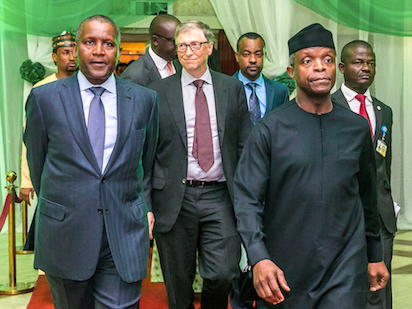
Nigeria’s Vice President Yemi Osinbajo (2ndR), Nigerian billionaire Aliko Dangote (L), and Microsoft founder Bill Gates (C) arrive to attend the closing ceremony of the National Economic Council (NEC) in Abuja on March 22, 2018. / AFP PHOTO

Gates, who stated this at expanded National Economic Council, NEC, presided over by Vice President, Prof. Yemi Osinbajo, said Nigeria’s fiscal situation was at a low equilibrium, adding that in return for low levels of service, people pay low levels of tax. 


The philanthropist disclosed that his foundation’s biggest office in Africa was Nigeria, where he had committed over $1.6 billion so far, with the intention of increasing his commitment in the country. 

He said Nigeria had unmatched economic potential but that what became of the potential depended on the choices its leaders make. 

Gates said:  “The most important choice you can make is to maximize your greatest resource, the Nigerian people. Nigeria will thrive when every Nigerian is able to thrive. 

“If you invest in their health, education and opportunities, the human capital, we are talking about today, then they will lay the foundation for sustained prosperity. If you don’t, however, then it is very important to recognise that there will be a sharp limit on how much the country can grow.   

Nigeria one of most dangerous places to give birth 

“Nigeria is one of the most dangerous places in the world to give birth, with the fourth worst maternal mortality rate in the world ahead of only Sierra Leone, Central African Republic and Chad. One in three Nigerian children is chronically malnourished. 

“I urge you to apply this thinking to all your investments in your people. The Nigerian government’s Economic Recovery and Growth Plan identifies ‘investing in our people as one of three strategic objectives.’ But the ‘execution priorities’ don’t fully reflect people’s needs, prioritizing physical capital over human capital. 

“To anchor the economy over the long term, investments in infrastructure and competitiveness must go hand in hand with investments in people. People without roads, ports, and factories can’t flourish. And roads, ports and factories without skilled workers to build and manage them can’t sustain an economy.

 “Right now, Nigeria’s fiscal situation is at what you might call a low equilibrium. In return for low levels of service, people pay low levels of tax. We hope to help you reach a higher equilibrium rooted in effective and transparent investments in people. This equilibrium would trigger a virtuous cycle.”  

 Buhari’s administration determined to rewrite

 Nigerian story

 In his remarks at the expanded NEC attended by the business class,  academia, traditional rulers and some world bodies, Vice President Osinbajo said high oil prices and economic growth of previous years had failed to translate into a better life for most Nigerians.

 According to him, instead, grand corruption prevented investments in healthcare and education and infrastructure, and shamelessly robbed government policies of most, if not all of their intended impact.

 Osinbajo, however, assured that the Muhammadu Buhari’s administration was determined to rewrite the Nigerian story for the better. 

  We’re investing in people through ERGP—Osinbajo

 “It is this realisation that has helped ensure that one of the primary planks of the ERGP is ‘Investing in our people.’ And it is for this reason that we are expanding the reach and quality of our healthcare through the National Health Insurance Scheme, NHIS; and working to guarantee basic education for all persons, while also upgrading and modernising the quality of secondary and post-secondary education. 

  To compete globally, we must prioritise investments —Dangote

 In his remarks, Chairman of Dangote Group, Aliko Dangote, told those in government should lead in human capital development, stressing that when that was done, there would be committed Nigerians.

 He said:  “For Nigeria to truly compete globally, we must prioritize investments in the health, education and opportunity of our people, alongside other critical areas as infrastructure. Together, these are the inputs that will make Nigeria richer.

“You, my friends in government, must lead. But when you do, you will have committed Nigerians like myself joining in the effort.

“In Nigeria, we have largely achieved growth by extracting natural resources and are now building on that through our physical infrastructure. But we must also remember that it is our young people that will drive our future success.” 

  Nothing wrong with ERGP—El-Rufai

 In an interview with State House correspondents, Governor Nasir el-Rufai of of Kaduna State insisted that it was not the question of adjusting the ERGP but the budgeting system with priorities set out clearly to address human capital development issues.

 He explained that what Bill Gates and Dangote told NEC members was that government at all levels also needed to do more.

 El-Rufai said yesterday’s NEC meeting was the most important held since the government of President Muhammadu Buhari came to power.

Bill Gates Visits Nigeria to Boost Global Fight Against Polio - Bill & Melinda Gates Foundation

Nigerian government to receive more than 100 million doses of oral polio vaccine (OPV) through innovative financing mechanism

federal governments, it can eradicate polio. Mr. Gates is in Nigeria to learn more about national immunization efforts and the country’s strategy to stop polio, a disease that still inflicts severe disability on Nigerian children. 
During a press conference in Abuja, Gates commended the renewed resolve he saw firsthand, and expressed optimism that leaders at all levels of the country will help create a movement to protect Nigerian children from polio and other vaccine preventable diseases.
While in Nigeria, Gates observed the efforts of vaccination teams during a nationwide immunization.  In Northern Nigeria, where the polio virus continues to circulate, he met with government officials, and traditional and religious leaders. He also met with mothers, traditional birth attendants, and representatives of a Muslim women’s association to discuss their personal experiences with immunization and ideas for achieving polio eradication.
The Gates Foundation also finalized a $25 million agreement with the World Bank to support the purchase of more than 100 million doses of oral polio vaccine (OPV) in Nigeria. The agreement stipulates the Gates Foundation will "buy down" a World Bank loan to the Nigerian government to support polio eradication efforts. Relief of the loan is triggered when Nigeria achieves certain polio program milestones within the next three years, such as attaining 80 percent vaccine coverage in each state. Rotary International and the UN Foundation have also used this innovative financing mechanism for vaccine purchase in Nigeria.
Including this new agreement, the Gates Foundation has committed more than $700 million to polio eradication efforts worldwide. The foundation is actively working with development partners to meet the program’s ongoing financial requirements.

Wednesday, May 11, 2016

Khloe Kardashian Defends Herself After Photoshopping Her Legs in Selfie

The Kardashians are well-known for many things, but if there’s one thing that they all stand out for, it’s their unbelievable ability to take flawless selfies. Still, Khloe Kardashian has recently come under fire for posting a picture of herself in the gym, post-workout, showing off her muscular abs and toned physique. So, what’s the problem, you ask? The image is apparently digitally altered.


After carefully looking at the image, fans were able to see a bend in the door behind Khloe, confirming that she had altered the size of her thighs in the picture. Seemingly unashamed, Khloe quickly told everyone that she had indeed distorted the shot, but left out a reason for why she did it.

Unsurprisingly, a confession simply wasn’t good enough for the Kardashian-Jenner fans. And their constant pestering eventually led Khloe to explain her reasoning behind the image — though it’s likely not what you’d expect. 
“Whenever I post a picture of my legs on Instagram, everyone comments on how f***** up my knees look,” she explained on her app. “It’s because I’ve had reconstructive surgery, you a*******! My right leg is an inch and a half thinner than my left because my muscles deteriorated and never recovered.”
So, just like the rest of us, Khloe was just trying to fix a part of herself that she felt insecure about. And considering how often we likely do that with our own social media posts, maybe it’s time to lay off with the judgment.

Tuesday, December 1, 2015

Vin Diesel Remembers Paul Walker on Second Anniversary Of Death

Vin Diesel is remembering Paul Walker on the second anniversary of the actor’s death.
http://img-s-msn-com.akamaized.net/tenant/amp/entityid/AAfQqVU.img?h=383&w=525&m=6&q=60&o=f&l=f&x=132&y=128

Walker was tragically killed in a car crash on November 30, 2013. At the time, the 40-year-old star was on a brief break from filming Furious 7. Diesel was understandably devastated over the death of his longtime friend and colleague.
Over the last two years, he has shared countless tributes in Walker’s memory. And on Monday, Diesel posted a new one that bitter-sweetly recognized the passage of time. “No matter where you are in this universe… You will always be, my brother,” he wrote. And on Instagram, Diesel shared a photo of himself and Walker with the words “Brotherhood Has No Limits.”

Colleague Tyrese shared a longer message of his own on Instagram. “It’s still not easy…… 2 years ago today… We lost our brother….. Today I’m just gonna lay low and process….. Clarity through Prayers and perspective is what I always seek and pray for….,” wrote the singer-actor.
Tyrese continued, “With a heavy heart I post this….. Please continue to pray for the Walker family and his real friends who was with him every single day…. They’re some of the best and strongest people I know…… I know you’re in heaven smiling and rooting for us all….. #RIH ( Rest in heaven ).”
Over the last year, Walker has remained a big part of his friends’ lives. In March, Diesel named his newborn daughter Pauline in the late actor’s honor. The following month, he was repeatedly celebrated as Furious 7 opened in theaters. And in August, the cast participated in a tribute during the Teen Choice Awards, where Diesel thanked Walker’s daughter Meadow for helping to keep their family “going.”
Meadow is currently embroiled in a wrongful death lawsuit against Porsche over the fatal accident. Just last week, Walker’s father filed a near-identical suit. Gossip Cop will update if more co-stars share tributes in Walker’s memory.

Adele's '25' Sales Rise to Over 4 Million in U.S.

 Adele photographed in 2015.

The sales keep climbing for Adele's blockbuster 25 album.
After processing the first sales reports through Nov. 29, Nielsen Music says that 25 has sold at least 650,000 copies in its second week on sale in the U.S. Combined with the 3.38 million 25 sold in its first week (Nov. 20-Nov. 26), the album has now sold more than 4 million in pure album sales. The album’s second tracking week began on Nov. 27 (the always-busy shopping day known as Black Friday). 
25 is the first album to sell more than 4 million copies in a calendar year since Adele's own 21 moved 4.41 million in 2012. (In fact, the only albums to sell at least 4 million in a calendar year since 2006 have been titles by Adele. Aside from 25 in 2015 and 21 in 2012, she also did it with 21 in 2011: 5.82 million.)
There are slightly more than four days left in the sales tracking week to be tabulated (as it ends at the close of business on Thursday, Dec. 3) . Some industry forecasters suggest the album could sell another million copies in its second week, making it the first album to sell a million copies in more than one week.
Billboard is scheduled to report 25's second-week sales on Sunday, Dec. 6, once Nielsen has finished processing its weekly data.

Drake is Spotify's most streamed artist of the year globally

  • FILE - In this Oct. 3, 2015, file photo, Drake performs at the Austin City Limits Music Festival in Zilker Park in Austin, Texas. Spotify announced its end-of-the-year list Tuesday, Dec. 1, 2015, and said Drake was the most streamed artist of the year globally, earning 1.8 billion streams in 2015. Rihanna was the year’s most streamed female performer with 1 billion streams, while Major Lazer’s ubiquitous hit, “Lean On,” was the most streamed song of the year with 540 million streams. (Photo by Jack Plunkett/Invision/AP, File)
  • FILE - In this Oct. 24, 2015, file photo, Rihanna performs at the 2015 We Can Survive Concert at the Hollywood Bowl, in Los Angeles. Spotify announced its end-of-the-year list Tuesday, Dec. 1, 2015, and said Drake was the most streamed artist of the year globally, earning 1.8 billion streams in 2015. Rihanna was the year’s most streamed female performer with 1 billion streams, while Major Lazer’s ubiquitous hit, “Lean On,” was the most streamed song of the year with 540 million streams. (Photo by Rich Fury/Invision/AP, File)
  • FILE - In this Nov. 7, 2015, file photo, Major Lazer arrive at the Cannes festival palace, to take part in the NRJ Music awards ceremony, in Cannes, southeastern France.Spotify announced its end-of-the-year list Tuesday, Dec. 1, 2015, and said Drake was the most streamed artist of the year globally, earning 1.8 billion streams in 2015. Rihanna was the year’s most streamed female performer with 1 billion streams, while Major Lazer’s ubiquitous hit, “Lean On,” was the most streamed song of the year with 540 million streams. (AP Photo/Lionel Cironneau, File)
  • FILE - In this Sunday, Nov. 22, 2015, file photo, Justin Bieber performs at the American Music Awards at the Microsoft Theater, in Los Angeles. Spotify announced its end-of-the-year list Tuesday, Dec. 1, 2015, and said Drake was the most streamed artist of the year globally, earning 1.8 billion streams in 2015. In the all-time lists, Bieber has the record for most streams in a day with 36 million streams, and Major Lazer’s “Lean On,” which features MO and DJ Snake, is the leading song. (Photo by Matt Sayles/Invision/AP, File)
  • FILE - In this Aug. 30, 2015, file photo, The Weeknd poses in the press room at the MTV Video Music Awards in Los Angeles. Spotify announced its end-of-the-year list Tuesday, Dec. 1, 2015, and said Drake was the most streamed artist of the year globally, earning 1.8 billion streams in 2015. The Weeknd’s breakout album, “Beautify Behind the Madness,” was the most streamed album of the year, beating Drake’s “If You’re Reading This It’s Too Late,” which was No. 2. (Photo by Richard Shotwell/Invision/AP, File)
NEW YORK (AP) — Spotify users are clearly listening to Drake. The rapper was the most streamed artist of the year globally.
Spotify announced its end-of-the-year list Tuesday and said Drake earned 1.8 billion streams in 2015. Rihanna was the year's most streamed female performer with 1 billion streams, while Major Lazer's ubiquitous hit, "Lean On," was the most streamed song of the year with 540 million streams.
The Weeknd's breakout album, "Beautify Behind the Madness," was the most streamed album of the year, beating Drake's "If You're Reading This It's Too Late," which was No. 2.
Ed Sheeran, who was the top streaming artist last year, was second behind Drake. The Weeknd, Maroon 5 and Kanye West rounded out the top five.
In the United States, Drake topped the list of most streamed artists, followed by the Weeknd, West, Sheeran and Eminem. Drake's "If You're Reading This" also topped the U.S. albums list, while Fetty Wap's "Trap Queen" was the most streamed song in America.
In Spotify's all-time lists, Sheeran is the most streamed act with more than 3 billion streams; Justin Bieber has the record for most streams in a day with 36 million streams; and Major Lazer's "Lean On," which features MO and DJ Snake, is the leading song.

Saturday, August 22, 2015

AshleyMadison.com Hackers Release Details Of 33,000,000 User Accounts

Hackers calling themselves the Impact Team, have posted 9.7 gigabytes of stolen customer details from AshleyMadison.com online for all to see.

The sensitive customer information was uploaded on Tuesday, and was initially only available via the anonymising Tor Web Browser. Enterprising coders have since created websites that make it possible to enter specific email addresses to see if they match the stolen customer records.
ashley madison

According to several reports, the files seem to include the login and account details for almost 33 million people, who at some point signed up for the site. The released files date all the way back to 2008. While they do not contain any actual credit card numbers, they do apparently include street addresses, names, and transactions  While users of AshleyMadison.com may have falsified their information when signing up, (such as giving a false name), unless they used a pre-paid credit card, then their information will be contained somewhere within the near 10 gigabytes of stolen details.
AshleyMadison.com is a dating website aimed fully at men and women who are already married, and are actively looking to have affairs. The company has courted controversy since its founding by Noel Biderman back in 2001, but has proved to extremely successful as a workable business model. The company whose motto goes “Life is short, have an affair,” is no stranger to controversy, priding itself on its pro-infidelity approach to life. However Ashley Madison also prided itself on being ‘discrete,’ which may now no longer be a selling point for future users of the site.
According to Impact Team’s initial statement posted online, part of their motivation was to target a company that lies, and “profits on the pain of others.”  Another motivating factor was apparently the fact that Ashley Madison’s full profile deletion option, that generated $1.7 million alone in 2014 for the company, is not quite as comprehensive as users might have hoped for: Users real names and addresses are still allegedly kept on file, and this information comprised part of Impact Team’s statement.
Impact Team said they would release all the customer records they had obtained unless AshleyMadison.com was taken “offline permanently in all forms.” Ashley Madison did not comply with this request. Avid Life Media, the company owning Ashley Madison, said in a statement: “This event is not an act of ‘hacktivism’, it is an act of criminality…”
The original theft of the Data took place in July, and evidence allegedly points to a former employee of Ashley Madison with inside knowledge of the company.

Sunday, August 16, 2015

Sex-mad Chelsea medic ruined my life


EXCLUSIVE: Eva said she bedded ace to upset me, claims ex-lover 

Passionate ... Chelsea doc Eva Carneiro Passionate ... Chelsea doc Eva Carneiro

CHELSEA doctor Eva Carneiro’s ex says they split after she taunted him by claiming she had sex with a player.
Eva, demoted after a row with Jose Mourinho, had a passionate relationship with Rupert Patterson-Ward for 15 months. He said last night: “This woman ruined my life.
“Eva would blurt out she had slept with one of the players during heated rows. She said it just to make me feel bad. I don’t believe it was true.’’

Besotted ... Eva's ex Rupert Patterson-Ward 
 Besotted ... Eva's ex Rupert Patterson-Ward

Rupert claims one Chelsea player called her to his hotel room and answered the door naked.
He added: “She prides herself on being popular among the players. Eva loved the attention.”
Chelsea fan Rupert, 33, spoke after Eva was dropped from the bench after a row with manager Jose Mourinho.
Mourinho labelled his medical team “naïve” after they rushed on to the pitch to treat Eden Hazard in the closing stages of their home game with Swansea last weekend.
The Belgian star had to walk off the pitch after Eva and physio Jon Fearn attended to him.
It left Chelsea, already a man down, with just nine players.

 Bust-up ...  Jose Mourinho blasts Eva during match
Bust-up ... Jose Mourinho blasts Eva during match

Advertising salesman Rupert began dating Eva in January 2012 and last night told how she is passionate, ruthless and gets whatever she wants.
And he revealed how the Gibraltar-born medic, now 41, once led him to the bedroom and declared: “Let me treat you.”
He said: “Eva is a very sexual woman and not many people know the real her.
“She’s ruthless and gets whatever and whoever she wants.
“I was besotted with her and we were planning a family, but she chewed me up and spat me out.

A touch of glass ... Eva downs wine on holiday in 2013
 A touch of glass ... Eva downs wine on holiday in 2013 

“She rubbished me because I earned less than £30,000 a year — what some footballers collect in a day. I tried so hard but nothing was good enough for her.”
He said: “Eva loved sex. It was so important to her. We would have sex every single day.
“She is a fiery and passionate woman who knows what she wants. I was an incredibly lucky man.
“We were blissfully happy. We were an item and wanted the world to know — two people very much in love.”
Rupert was so keen to impress her he embarked on a rigorous gym regime in a bid to look more like the hunky football stars she worked with on a daily basis.
But one of his workouts left him in agony when he pulled a shoulder muscle.

With Rupert ... couple before she dumped him
 With Rupert ... couple before she dumped him

He said: “I was doubled up and really hurting. When Eva came back she saw I was in pain.
“She took me to her bedroom, and with a twinkle in her eye said, ‘I need to treat you’.
“She tore off my clothes, glanced at my shoulder, jumped on me and we had passionate sex.”
But months later, as their relationship floundered, he claims she taunted him by bragging that she’d had sex with a player during their time together.
Rupert said: “Eva would blurt out she had slept with one of the players during heated rows.
“She said it just to make me feel bad. I don’t believe it was true.’’
The fact the couple were dating was the subject of Chelsea fans’ blogs. One posted a photo of Eva and Rupert with the message: “A million dreams have just been shattered... Eva and her boyfriend.”

Cleopatra ... her club party outfit
 Cleopatra ... her club party outfit 

Eva joined Chelsea in 2009 and former manager Andre Villas-Boas brought her into the first-team fold in 2011. She is regarded as a top-class professional and one of the best sports medics in the game.
Rupert first met her at Frankie’s sports bar in the club’s Stamford Bridge complex. He said: “I was a bit tipsy and loose-tongued and went over and began chatting.
“She was with her parents but I didn’t care. I chatted for as long as I could without freaking her out, and made sure she had my name, phone number, email, you name it.
“That day was like a Carlsberg TV ad.”
Rupert believes Eva mistakenly thought he worked at Chelsea FC. But he was welcomed into the inner sanctum of the club as her boyfriend and was on friendly terms with the team’s superstars.
Pet pooch ... the doctor with her dog
He said: “Eva got me tickets to every home game. I’d go to lots of away matches too.
“Everyone at the club knew who I was. I was invited to the homes of Florent Malouda and Petr Cech.
“I travelled to Munich for the Champions League final with John Terry’s wife Toni, Frank Lampard’s partner Christine Bleakley and all of the team’s friends and family.
“John knew who I was and I’d shake hands with Didier Drogba and others. It was amazing.”
During a lavish trip to Marbella, Eva asked Rupert if he would consider moving to Spain so they could live close to her family.
He said: “I answered ‘yes’ in a flash. We were so in love.
“We discussed having children. We had sex a million times.
“She could have fallen pregnant any day.”
Cup cake ... she enjoys a tasty treat
Cup cake ... she enjoys a tasty treat Tim Stewart News Limited
But Rupert told how Eva’s high-pressure job means she can change emotions in an instant.
They began having bust-ups in September 2012.
Rupert sub-let his flat and moved into Eva’s property in Earlsfield, South London, but their rows became more frequent.
He was so worried he was losing her that he once hired a £50,000 Jeep 4x4 to pick her up from Chelsea’s training ground in Cobham, Surrey. But the cracks in the relationship began to deepen.
Rupert said he “saw the real Eva” when she briefly dumped him after her 39th birthday because he “hadn’t made enough effort”.
New Year’s Eve at a pub was also a disaster when Eva and Rupert were joined by her parents.
He said: “I saw Eva give out her number to another guy. I got drunk and went home alone.
“Later in Eva’s bedroom, she slapped me hard with both hands around my face. She then kicked me out of the house in front of her parents. I had nowhere to go and it was humiliating. We patched things up a day or two later.”
Rupert said whenever he rowed with Eva she would pull out her claim that she had slept with one of the Chelsea squad.
On hols ... pair together in June, 2013
He said: “She told how one footballer would constantly hit on her, parading around naked in front of her at every opportunity in the dressing room and making sure she got a real eyeful.
“After one match he called her to his hotel room and answered the door completely starkers.
“Eva rubbed my nose in it when we rowed. It was cruel.
“She is a fiery Latino, sex-mad, and prides herself on being popular among the players. Eva loved the attention.”
He said the professional demands placed on her by the team put a huge strain on the relationship.
“He recalled: “We would be sitting at home watching TV and she would have calls from players at 9pm or 10pm. They would have had a sore leg or had pulled a hamstring.
“She always went and returned in the early hours. I had to get my head around the fact she would be giving players rub downs.”
The end for Rupert came after an ill-fated trip to Marbella at the end of the 2013 season. He said: “She never spoke to me again.”
Rupert, who has since found new love, said of Eva: “She loves hanging around rich guys with huge egos. I think she liked me because I was different, but ultimately I wasn’t enough for her.”

Sunday, July 26, 2015

Jihadi John On The Run, From ISIS

RTR4R9OY
Mohammed Emwazi, who is believed to be the killer Jihadi John in several beheading videos released online by the Islamic State group, may have worn out his welcome with the terrorist organization. Emwazi reportedly fled the militant group in Syria several weeks ago, bound for North Africa.
Emwazi, once a London resident, apparently fears the militant group formerly known as either ISIL or ISIS will drop him “like a stone or worse if they feel he is no longer of any use to them,” a source told the Daily Express newspaper in the U.K. The source added, “So it is possible he will end up suffering the same fate as his victims.”
The 26-year-old gained notoriety when identified as Jihadi John, who had brutally beheaded journalists and humanitarian-aid workers from the U.S. and Britain in propaganda messages released by the Islamic State group over the past year. The Express reported the loss of anonymity has terrified Emwazi.
A priority of the American and British special forces fighting the Islamic State group in Iraq and Syria is to track down Emwazi, who is concerned that jealous fellow militants may be plotting against him, the Daily Express reported.
Emwazi, a Kuwait-born U.K. immigrant who holds a degree in computer science from the University of Westminster, may be laying low with a lesser-known jihadist group in Syria. He is wanted by allied forces for questioning in the killings of James Foley, David Haines, Alan Henning, Peter Kassig and Steven Sotloff.
A former friend of Emwazi told the Express that the jihadist had not been “a good Muslim” and never wore the Islamic dress he has been seen wearing in the beheading videos. “He smoked drugs, drank and was violent towards other boys,” said the friend, who was not named in the report. “The fact he portrays himself as a strict Muslim is laughable and shameful.”

Saturday, June 20, 2015

Dylann Roof Photos and a Manifesto Are Posted on Website


Dylann Roof Photos and a Manifesto Are Posted on Website

Photo
 
COLUMBIA, S.C. — Dylann Roof spat on and burned the American flag, but waved the Confederate.
He posed for pictures wearing a No. 88 T-shirt, had 88 Facebook friends and wrote that number — white supremacist code for “Heil Hitler”— in the South Carolina sand.
A website discovered Saturday appears to offer the first serious look at Mr. Roof’s thinking, including how the case of Trayvon Martin, the black Florida teenager shot to death in 2012 by George Zimmerman, a neighborhood watch volunteer, triggered his racist rage. The site shows a stash of 60 photographs of Mr. Roof, many at Confederate heritage sites or slavery museums, and includes a racist manifesto in which the author criticized blacks as being inferior while lamenting the cowardice of white flight.
“I have no choice,” it reads. “I am not in the position to, alone, go into the ghetto and fight. I chose Charleston because it is most historic city in my state, and at one time had the highest ratio of blacks to Whites in the country. We have no skinheads, no real KKK, no one doing anything but talking on the internet. Well someone has to have the bravery to take it to the real world, and I guess that has to be me.”
The website was first registered on Feb. 9 in the name of Dylann Roof, the 21-year-old man charged with entering a black church in Charleston Wednesday night, attending a prayer meeting for an hour and then murdering nine parishioners. The day after the site was registered, the registration information was intentionally masked.
It is not clear whether the manifesto was written by Mr. Roof or if he had control of it. Nor is it clear whether he took the pictures with a timer, or if someone else took them. The F.B.I. and Charleston police officials say they are examining the site.
But if it is genuine, as his friends seem to think, the tourist sites he visited, the pictures that were posted and the hate-filled words filling the site offered a chilling glimpse into the interests of an unemployed high school dropout said to have a fixation on race and a murderous rage.

“This whole racist thing came into him within the past five years,” said Caleb Brown, a childhood friend of Mr. Roof’s who is half-black. “He was never really popular; he accepted that. He wasn’t like, ‘When I grow up I am going to show all these kids.’ He accepted who he was, and who he was changed, obviously.”
Mr. Roof, who is accused of being the lone gunman who entered the Emanuel A.M.E. Church Wednesday night and unleashing a murderous rampage with a .45 handgun, has been charged with nine counts of murder in connection with the killings. Victims included the Rev. Clementa C, Pinckney, who was both the church pastor and a state senator.

Mr. Roof, who was first identified by surveillance footage released the morning after the killings, is being held at the Charleston County jail, along with a North Charleston police officer charged with shooting an unarmed African-American motorist in the back in April.

Continue reading the main story
Mr. Roof’s friends say that he only spoke of his racist leanings once — when he recently warned that he planned to do something crazy with the gun he had purchased with the money he got from his parents for his 21st birthday. But they say he was bothered by the uproar surrounding the Trayvon Martin case.
Continue reading the main story Video

Victims’ Families Address Dylann Roof

Family members of those killed Wednesday at Emanuel African Methodist Episcopal Church in Charleston, S.C., addressed the shooting suspect, Dylann Roof, in court.
By Associated Press on Publish Date June 19, 2015. Photo by Pool photo.
The website, the lastrhodesian.com, features a photo of a bloodied dead white man on the floor. The picture appears to be a shot from “Romper Stomper,” an Australian movie about neo-Nazis. It was first discovered by a blogger who goes by the pen name Emma Quangel.
The blogger was inspired by another Twitter user to pay $49 for a reverse domain search that turned up the site.
According to web server logs, the manifesto was last modified at 4:44 p.m. Eastern time on Wednesday, the day of the Charleston shootings, and the essays notes: “at the time of writing I am in a great hurry.”
The manifesto says: “The event that truly awakened me was the Trayvon Martin case. I kept hearing and seeing his name, and eventually I decided to look him up. I read the Wikipedia article and right away I was unable to understand what the big deal was,” the essay says. “It was obvious that Zimmerman was in the right. But more importantly this prompted me to type in the words ‘black on White crime’ into Google, and I have never been the same since that day.”
 

Violent History: Attacks on Black Churches

The killing of nine people at the Emanuel African Methodist Episcopal Church in Charleston, S.C., is among a long list of attacks targeting predominantly black churches in the United States. 


The account cites the website of the far-right Council of Conservative Citizens as a site he learned from.
A friend of Mr. Roof’s, Jacob Meek, 15, said the references to the Trayvon Martin case made it clear that Mr. Roof had written the essay. “That’s his website,” he said. “He wrote it, and I just can tell.”
Watchdog groups that track right-wing extremism say the manifesto reflects the language found in white supremacist forums online and dovetails with what has been said about Mr. Roof thus far — that he had self-radicalized, and that he did not belong to a particular hate group. “It’s clear that he was extremely receptive to those ideas,” said Mark Pitcavage, the director of the Anti-Defamation League’s Center on Extremism. “At the same time, he does not have a sophisticated knowledge of white supremacy.”
In one picture, Mr. Roof is shown posing with wax figures of slaves. In others, he posed with a handgun that appears to be a .45-caliber Glock. He had a .45-caliber Glock in his car when he was arrested Thursday, the police said.

Mr. Roof is alone in all the photos, which show a slave plantation; Sullivan’s Island, S.C.; and the Museum and Library of Confederate History in Greenville, S.C. He sports the same gloomy look in many of the photos, but others depict nature scenes and vacation photographs.
According to the Southern Poverty Law Center’s glossary of racist skinhead terms, “Fourteen stands for the ‘14 words’ slogan coined by David Lane,” who died in 2007 while serving a 190-year sentence for his part in the assassination of a Jewish talk show host. The slogan, according to the center, is “‘We must secure the existence of our people and a future for white children.” The letter H is the eighth letter of the alphabet, so 88 is a known code for “Heil, Hitler.” The website’s links contain several passages of long racist rants, saying Hispanics are enemies and “Negroes” have lower I.Q.s and low impulse control. The writings are not signed.
Mr. Roof’s Tumblr had contained photos that matched his Facebook page, but both were taken down after the killings.
The manifesto discovered Saturday uses defamatory terms for blacks, whom he accused of being “stupid and violent” with “the capacity to be very slick.” It laments white flight, and suggested that the whites should instead stay behind in cities and fight.
Criticisms are levied at Hispanics and Jews, but Asians are praised for being racists and potential allies. Whites are unfairly portrayed as all having been slave owners, the essay says. In reality, the author wrote, slavery was not that bad.
Mr. Brown said his friend’s transformation appeared to have occurred after he transferred to a new high school in Lexington.
“He wasn’t putting on Facebook ‘I hate black people. I am going to shoot up a church,” Mr. Brown said.